UR Code Security Features
Learn more about the Security Features for UR Codes.
Digital Signature Verification
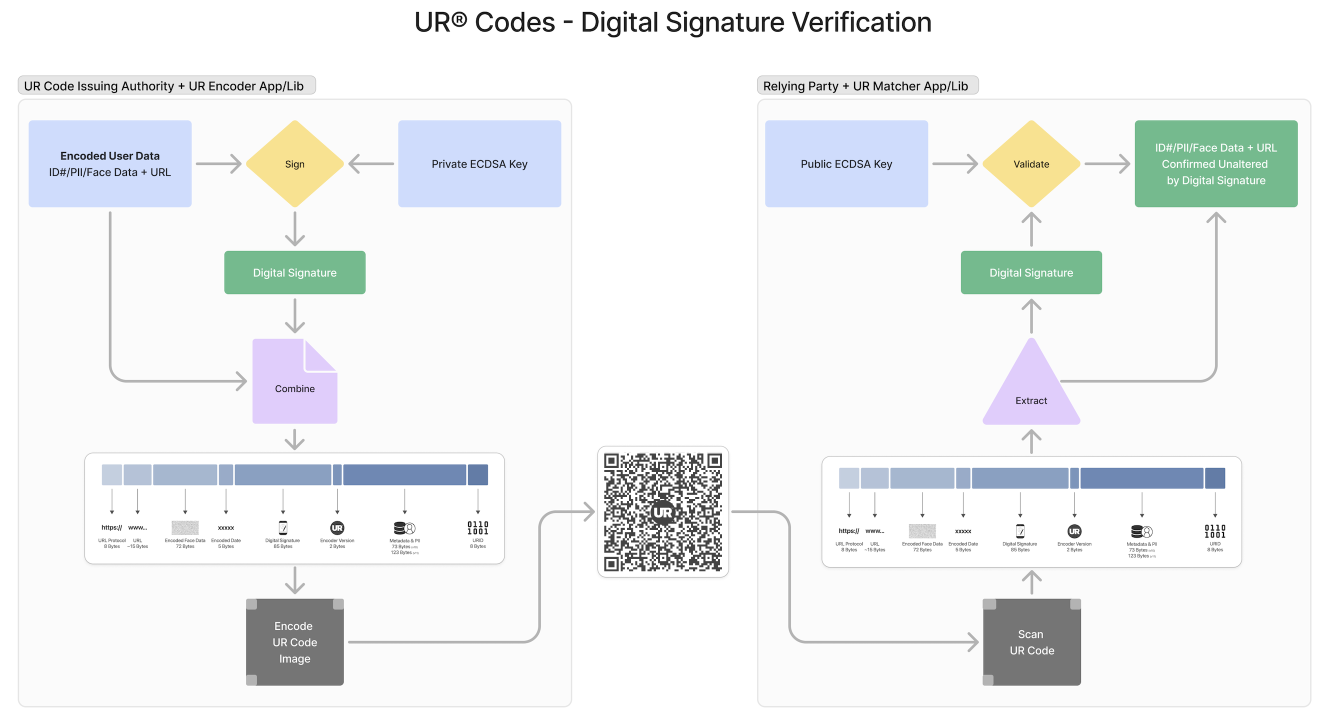
Elliptic Curve Digital Signature Algorithms (ECDSA) are used to sign the contents of the UR Code with the UR Code Private Key. The UR Code is verified against the corresponding Public Key to verify the Digital Signature. This ensures that the UR Code was generated by the owner of the Private Key corresponding to the Public Key and ensures the contents of the UR Code have not been modified.
There are currently two curves supported for the Digital Signature embedded in UR Codes.
- The secp256k1 curve (the same curve used to secure Bitcoin, and referenced in NIST SP 800-186).
- The ed25519 curve (another curve recommended by NIST).
To learn more about these curves, please see UR Codes - Supported Curves.
It is also possible to support different curve types based on security opinions. However, most curves generate larger Digital Signatures, which could make the UR Code unusable due to the size of the code matrix required.
Privacy Protection
UR Codes do not contain Face Image Data, making them superior (from a privacy perspective) to any solution that requires Face Images to be scanned, transmitted, processed, and stored.
User PII/Metadata present in the UR Code can be encrypted for ultra-secure or ultra-private use cases. Note that in most IDV/KYC use cases, the User's PII/Metadata already exists in plain text on User Documents.
Metadata with Expiration or Issue Dates
Certain UR Codes, such as Driver Licenses and Passports, may have Metadata containing Expiration or Issue Dates. Relying Parties can use the Expiration and Issue Dates in their Business Logic to make specific decisions on how to process the Metadata.
Expiration Dates may be useful in determining if an Official Government Document or License is still valid.
Issue Dates may be relevant for setting the match thresholds for UR Code Images. As humans age, they will no longer match as high against the face data from when they were younger.
Revocation Lists
UR Codes that have associated privileges, such as Driver Licenses and Passports, or UR Codes with identity data that has been legally changed (by marriage, for example) can be revoked by the Issuing Authority.
The process requires the Relying Party to check the URID Number in the UR Code against the Issuing Authority's Revocation List, which can be done at the same time as and on the same URL as retrieving the Public Key for Digital Signature validation. The UR Code Matcher Software can be configured to scan the Issuing Authority URL under /UR/Revoked_URIDs.txt, and if the URID is present on the list, then the Issuing Authority has revoked the UR Code associated with that URID Number.
Privacy is preserved by the Revocation List method because the presence of the URID Number on the Revocation list is used to determine if the UR Code has been revoked, not the legal name or permanent ID number.
Revoked lists can be used in conjunction with Expiration Dates to limit the need for expired UR Codes to be listed in the URID Revocation List.
Revocation Lists can be used to remove the privileges assigned to the identity that was issued the UR Code, but the ability to scan and match the face to the UR Code for identification purposes remains intact.
Independent Security Testing
The UR Code Protocol has been subject to Rigorous Independent Security Testing by Praetorian Security Inc. Praetorian's Reverse Engineering Analysis focused on identifying Hashing Mechanisms, Encryption Keys, and Customer PII. During this analysis, Praetorian identified the following:
- 0 Critical Risk Issues
- 0 High Risk Issues
- 0 Medium Risk Issues
- 0 Low Risk Issues
- 0 Informational Risk Issues
In addition to its Reverse Engineering Analysis, Praetorian also tested the security of the UR Code APIs' Cryptographic Operations, the stability of the UR Code APIs, and the functionality of Generated URIDs. Aside from one Informational Risk Issue*, Praetorian's Security Assessment Testing found no issues affecting the currently shipped SDKs.
* The Informational Risk pertains to Private Key Generation. The correct OpenSSL commands need to be used when generating Private Keys. Issuing Authorities can use the UR Codes - Keys & Digital Signatures Guide to learn how to generate Private Keys with OpenSSL.